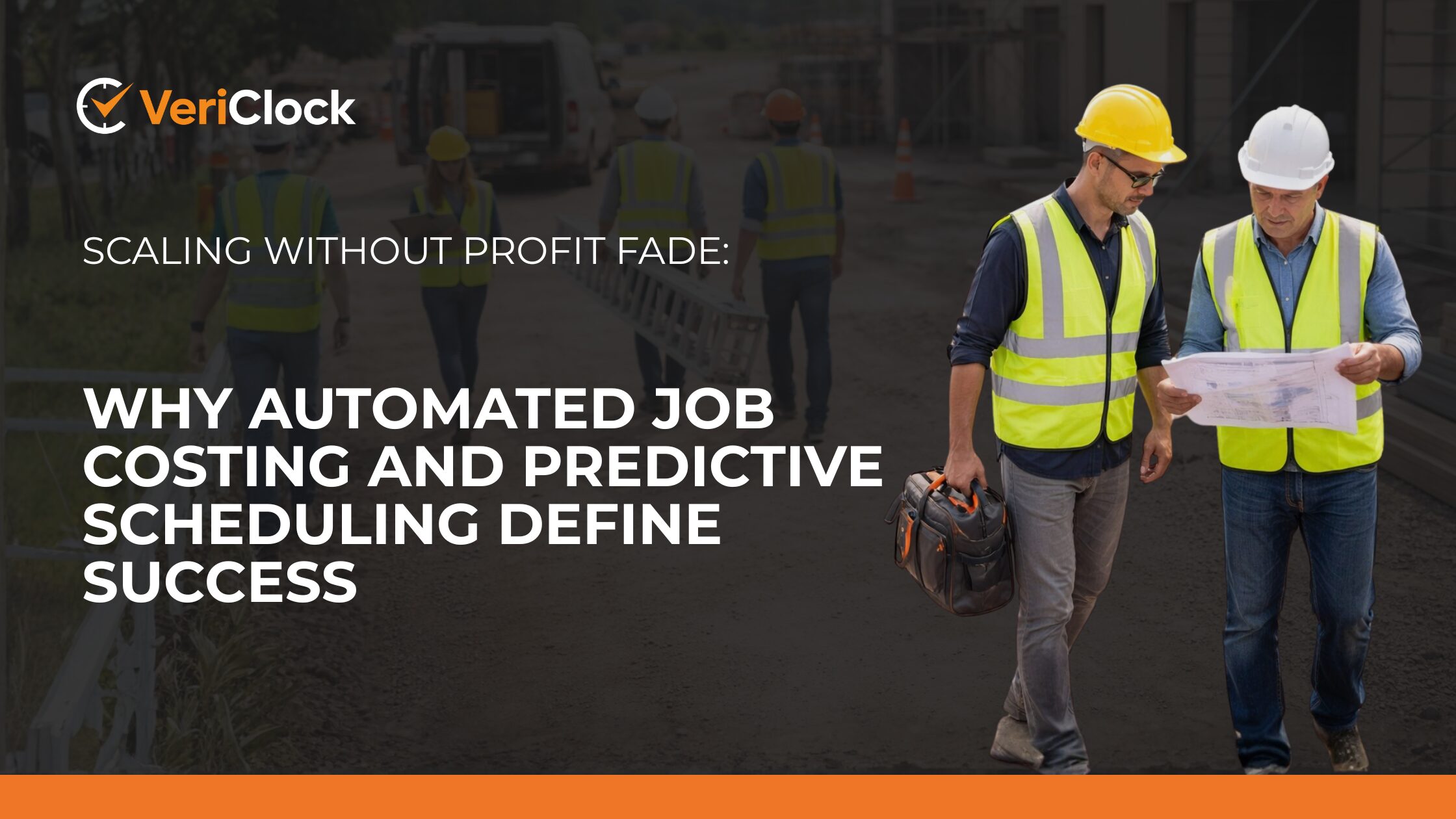
Are unverified labor costs actively eroding your project profitability?
For scaling small businesses across construction, maintenance, cleaning, healthcare support, infrastructure, and other field-based industries, accurately tracking labor costs to specific jobs is often the razor-thin difference between success and stagnation.
Labor is the largest controllable expense on most projects. When time is not verified, coded correctly, and aligned with job and schedule data, profitability doesn’t collapse overnight — it erodes quietly. It surfaces later as payroll corrections, unexplained job cost variance, overtime surprises, or financial reports leadership hesitates to trust.
In 2026, automated job costing and predictive scheduling are not operational upgrades. They are financial control systems.
The businesses that scale will not simply grow revenue. They will protect margin as operational complexity increases.
Basic Time Tracking Does Not Protect a Multi-Site Workforce
Clock-in apps were built for attendance. They were not built for job costing discipline, payroll accuracy, labor forecasting, or coordinating a multi-site, multi-job workforce.
At 8 employees, informal oversight works. At 30 employees across multiple active job sites, it does not.
As headcount grows, exposure compounds:
- Job misallocation becomes harder to detect
- Overtime rules are applied inconsistently
- Payroll processing slows under correction pressure
- Budget variance becomes reactive instead of controlled
Reactive systems create operational ambiguity. Scaling requires enforcement built into the workflow.
Margin Erosion Begins with Labor Budget Drift
Without enforced job and task selection at clock-in, administrators reconcile instead of manage.
Supervisors approve time without seeing budget impact. Overtime is discovered after it is incurred. Spreadsheets become shadow control systems. By the time payroll runs, variance is already embedded.
Manual exports and post-entry edits introduce:
- Delayed payroll processing
- Duplicate data handling
- Increased compliance exposure
- Job cost reports leadership questions
Automated job costing shifts control upstream.
When employees clock into specific Jobs and Tasks — and overtime rules apply automatically — labor discipline is enforced at capture. Modern systems generate automated alerts that surface overtime risk and budget variance before payroll closes, allowing managers to intervene mid-cycle.
Control is proactive. Not reconstructive.
Inaccurate Job Costing Weakens Pricing Strategy
Scaling depends on confident bidding.
If labor data is not granular and enforced when time is captured, future estimates rely on assumption rather than verified performance.
For field-based businesses, job costing is the margin engine.
Without it:
- Profitable services cannot be clearly identified
- Underperforming contracts remain hidden
- Labor forecasting becomes unreliable
- Strategic expansion slows
Accurate job costing is not about better reporting. It is about protecting pricing discipline with verified labor data tied directly to each job and task.
That discipline begins at clock-in — not at payroll.
From Time Tracking Tool to Operational Safeguard
Leading small and mid-sized businesses now treat their time tracking platform as an operational command center.
It connects job costing, payroll accuracy, scheduling, and accounting into one controlled system — shifting the focus from tracking hours to managing labor as a financial asset.
Predictive Scheduling: Controlling Labor Before It Impacts Profit
Automated job costing protects margin after work begins. Predictive scheduling protects it before work starts.
For businesses managing multiple crews and dynamic workloads, scheduling determines labor efficiency. The shift is clear: move from static spreadsheets to integrated, mobile-first predictive scheduling.
Modern predictive scheduling enables:
✅ Real-time schedule visibility
✅ Instant shift notifications
✅ Digital time-off requests
✅ Assignment acknowledgment
✅ Instant schedule edits
✅ Visibility into labor allocation by job
When labor moves, the financial impact is visible. Managers can see whether a job is trending over budget or approaching overtime thresholds and adjust before margin is affected.
Scheduling becomes financial management. Labor planning becomes margin protection.
Seamless Integration Eliminates Reconciliation Risk
Manual reconciliation between time tracking and accounting systems is a common margin leak.
Integrated time tracking software that connects directly with Sage 50, Sage 100 Contractor, and QuickBooks eliminates this risk.
When time is approved:
✅ It flows directly into payroll
✅ No exports
✅ No spreadsheet edits
✅ No duplicate entry
This reduces errors, accelerates payroll, and minimizes compliance exposure.
Seamless Sage integration and QuickBooks integration are financial safeguards — not just efficiency upgrades.
Compliance and Audit Readiness by Design
Growth increases scrutiny. Paper systems and editable spreadsheets do not provide defensible audit trails.
Automated systems provide:
✅ Digital record of every clock-in and edit
✅ Enforced job and task selection
✅ Automatic overtime rule application
✅ Role-based approval tracking
✅ Traceable payroll data flowing directly into accounting
Auditors evaluate systems, not intentions. Prevention-based systems reduce exposure before disputes arise.
Where VeriClock Fits
VeriClock supports multi-site, multi-job workforces with integrated time tracking software that combines automated job costing and predictive scheduling.
It enables:
✅ Job and task-level clock-in
✅ Automated overtime calculations
✅ Predictive mobile scheduling
✅ Real-time labor reallocation visibility
✅ Automated variance alerts
✅ Direct integration with Sage 50, Sage 100 Contractor, and QuickBooks
VeriClock replaces reactive payroll correction with enforced financial discipline.
Scaling Requires Prevention, Not Cleanup
In 2026, growth is not about adding headcount faster. It is about protecting margin as complexity increases.
The businesses that scale confidently will enforce control before payroll closes — not repair errors after the fact.
Start your free VeriClock trial today and experience how prevention-based payroll control eliminates downstream correction before your next pay cycle.