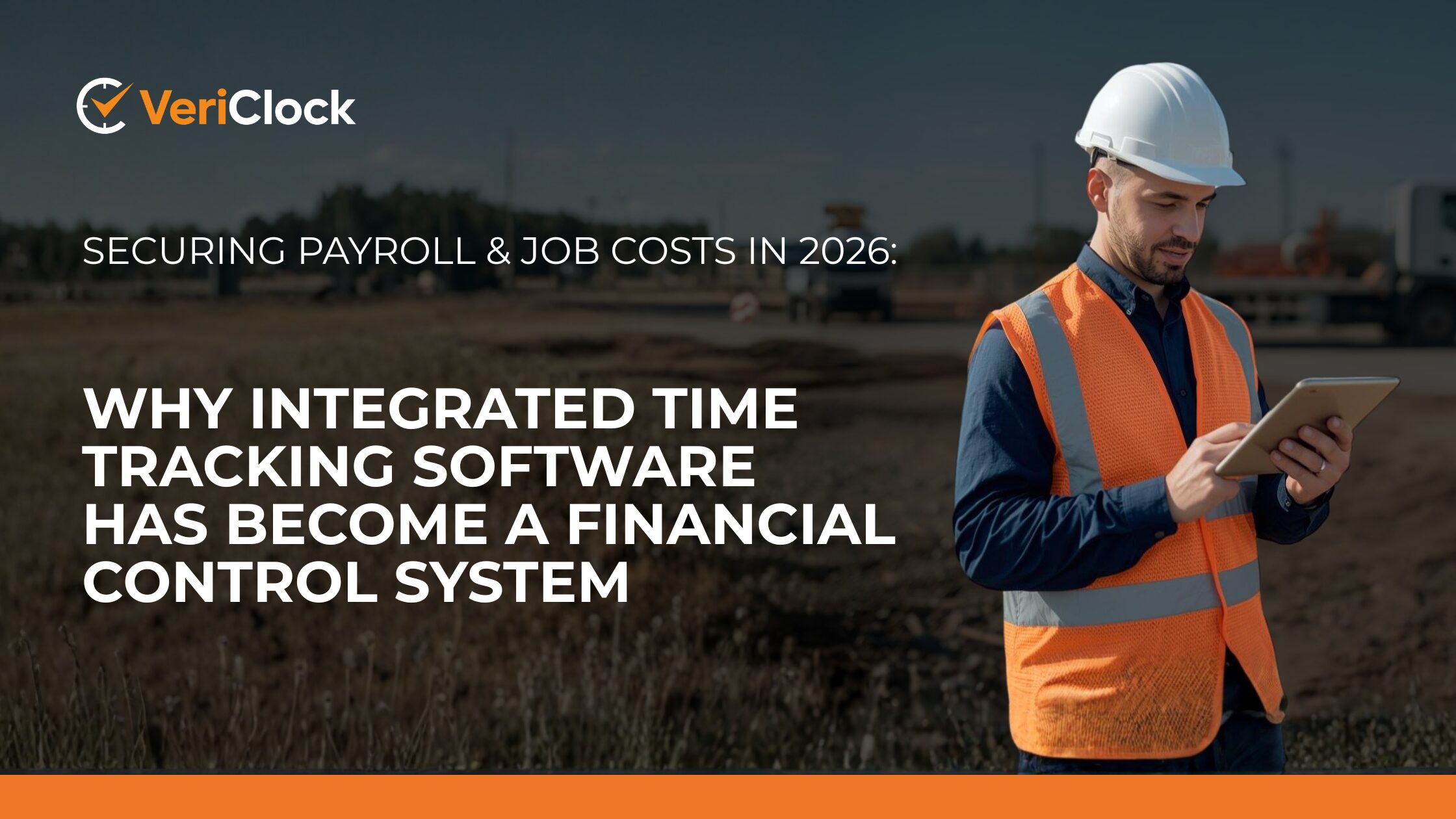
In construction, property maintenance, cleaning services, healthcare support, infrastructure, and other field-based industries, labor is the largest controllable operating expense. For many firms, it represents 30–50% of total project or contract cost.
Yet the systems used to capture that labor data are often treated as administrative tools — disconnected from financial risk management.
That disconnect is becoming dangerous.
If your payroll team is correcting time exports before importing them into Sage, QuickBooks, or another accounting system, your organization is operating in a reactive model — and in today’s labor environment, reactive models create measurable financial exposure.
Time tracking software is no longer just about capturing employee hours. It sits directly in the financial control chain between field labor and the general ledger.
When labor data breaks down, financial visibility breaks down with it.
Labor Volatility Has Raised the Stakes
The U.S. Bureau of Labor Statistics (BLS) reports continued wage growth across construction, maintenance, healthcare support, and service occupations. Higher hourly rates amplify the financial impact of every payroll miscalculation — whether in a skilled nursing facility, a property maintenance crew, a civil highway project, or a multi-site cleaning operation.
At the same time, industry organizations including the Associated General Contractors of America (AGC) continue to report persistent labor shortages across construction and infrastructure segments. Similar workforce tightness is visible in home health care, facility services, painting, MEP trades, and specialty service providers.
When workforce availability tightens, overtime usage increases — and with it, payroll complexity.
Taken together, these forces create a simple reality:
When labor costs rise and margins tighten, payroll inaccuracies are no longer minor inefficiencies — they are profit leaks.
In higher-wage environments, small payroll errors compound faster than most balance sheets can absorb.
The Structural Weakness of Manual Time Tracking and Payroll Workflows
Many mid-sized field-based organizations operate on a familiar sequence:
✅ Export time data, correct it, reconcile discrepancies
✅ Import into Sage, QuickBooks, or another accounting system
✅ Make final adjustments
This workflow persists because it “works.” But it works by absorbing error through administrative labor.
Every manual correction introduces financial risk through overtime miscalculations or misallocated job costs, compliance risk through inconsistent rule enforcement and incomplete audit trails, and operational risk through dependency on institutional knowledge rather than system logic.
The true cost is not the correction itself. It is the cumulative erosion of data integrity.
When payroll depends on repair, reporting loses credibility.
When time data is modified after capture, downstream reporting declines in precision. Payroll may balance, but job cost reports become less reliable — and when reliability declines, strategic decision-making slows.
If leadership hesitates to trust labor reports, execution slows with it.
Compliance Enforcement Is Becoming Less Forgiving
Wage-and-hour enforcement has grown more rigorous across multiple jurisdictions in both the United States and Canada. Field-based industries face additional complexity from daily overtime thresholds in certain states and provinces, prevailing wage classifications, multi-site workforce deployment, remote job locations with inconsistent connectivity, and variable shift structures common in healthcare and maintenance environments.
In this environment, compliance depends on rule consistency.
Manual systems rely on human interpretation.
Integrated time tracking systems rely on programmed enforcement.
That distinction matters.
If overtime logic is applied at payroll rather than at time entry, discrepancies accumulate before they are detected. In an audit scenario, reconstruction is far more difficult than prevention.
Auditors evaluate systems, not intentions.
Prevention requires enforcement at the source.
The Impact on Job Cost Integrity
Time tracking does not exist in isolation. It feeds directly into your accounting system and project reporting.
Whether managing construction crews, maintenance contracts, home health care staffing, cleaning routes, civil infrastructure projects, painting teams, or MEP service calls, time data shapes financial visibility.
When entries are adjusted during export or corrected during payroll processing, the final data recorded in your accounting platform may not reflect how labor was actually performed.
This creates distortion in project profitability analysis, contract margin tracking, bid accuracy, labor forecasting, and crew benchmarking.
Inaccurate labor data does not just affect payroll — it affects pricing discipline and margin control. Financial strategy cannot outrun flawed labor inputs.
From Administrative Tool to Financial Control
The shift underway is not about features. It is about control.
An integrated time tracking system validates data at the moment of entry. Job codes, projects, or service items are enforced at clock-in. Overtime rules are applied automatically. Approvals are captured digitally. Edits are logged transparently. Data flows directly into Sage, QuickBooks, or another accounting system without manual re-keying.
The result is not merely efficiency.
It is structural integrity in the payroll-to-job-cost pipeline.
When time data is validated upstream, the organization moves from correcting risk to controlling it.
Control at the labor layer protects every layer above it.
Where VeriClock Fits
VeriClock is a construction and field service time tracking software solution designed for teams operating within Sage 50, Sage 100 Contractor, QuickBooks, and other accounting environments across construction, property maintenance, healthcare support, and specialty service sectors.
Its value is not in feature count. It is in structural alignment:
✅ Automated rule enforcement at entry
✅ Job and cost code validation
✅ GPS-supported verification
✅ Mobile, kiosk, SMS, and phone-based time clocking for distributed crews
✅ Direct payroll integration without export manipulation
The objective is simple: eliminate downstream correction.
When payroll does not require repair, compliance becomes measurable. When job cost data does not require adjustment, leadership decisions become clearer.
Precision at entry creates confidence at close.
Final Perspective
Time tracking software is no longer a peripheral tool.
It sits at the intersection of payroll accuracy, compliance risk, and margin visibility.
Organizations that treat time tracking as a financial control mechanism — rather than an administrative necessity — operate with greater precision in increasingly volatile labor environments.
If your current process depends on correction after the fact, it may be time to evaluate whether your time tracking system is protecting your financial structure — or quietly introducing exposure.
Start your free VeriClock trial today and experience how prevention-based payroll control eliminates downstream correction before your next pay cycle.