Most businesses don’t lose employees because of culture alone.
They lose them when trust breaks down.
For construction crews, cleaning & maintenance teams, healthcare support staff, and other field-based workforces, payroll inconsistency is one of the fastest ways that trust erodes. When pay feels unpredictable, schedules are unclear, and corrections happen after the fact, frustration builds.
Employee engagement isn’t built on perks and culture alone.
It depends on accuracy, transparency, and predictability.
When those foundations slip, retention quickly follows.
Where Retention Actually Breaks Down
In many field-based businesses, time tracking is still loosely structured. Hours are captured quickly, reviewed later, and corrected before payroll.
That creates friction in five predictable areas:
- Late pay corrections
- Overtime miscalculations
- Broken or unclear scheduling
- Lack of approval transparency
- No structured enforcement at capture
None of these feel catastrophic in isolation.
But together, they create a system employees stop trusting.
Manual Time Tracking Creates Hidden Retention Risk
Manual and loosely structured time tracking introduces more than administrative overhead — it introduces measurable financial and employee risk.
Industry research consistently shows:
- The American Payroll Association estimates payroll errors impact 1–8% of total payroll
- Time-related inaccuracies alone can represent up to 7% of gross payroll
- Research from ADP indicates nearly 1 in 4 employees have experienced a payroll error
For small and growing field-based businesses, that exposure compounds quickly.
But the financial impact is only part of the problem.
Employees notice.
Even when errors are corrected, the experience creates friction. According to workforce studies from UKG, payroll inconsistency is one of the fastest ways to erode employee trust.
That’s where retention begins to break down.
Employees don’t leave after one payroll issue — they leave after repeated inconsistency.
Payroll Should Be Predictable — Not Negotiated
Retention improves when employees know exactly what to expect.
That means:
- Time is captured accurately
- Overtime is applied consistently
- Pay reflects what was worked — without adjustment
- Approvals are visible and traceable
When time tracking is loosely enforced, payroll becomes reactive. Supervisors fix issues after submission. Administrators adjust hours before processing.
The issue is not always error.
It is uncertainty.
Why Structure Builds Trust
Retention is not just about pay — it is about confidence in the system behind it.
This is where structured time tracking becomes critical.
In unstructured workflows, time is submitted, reviewed, and often adjusted without clear visibility. Employees don’t know what changed — only that their pay may differ from what they expected.
With systems like VeriClock, time moves through a defined approval process before payroll runs.
👉 Setting Up Time Entry Approval Workflows – VeriClock
Why this matters:
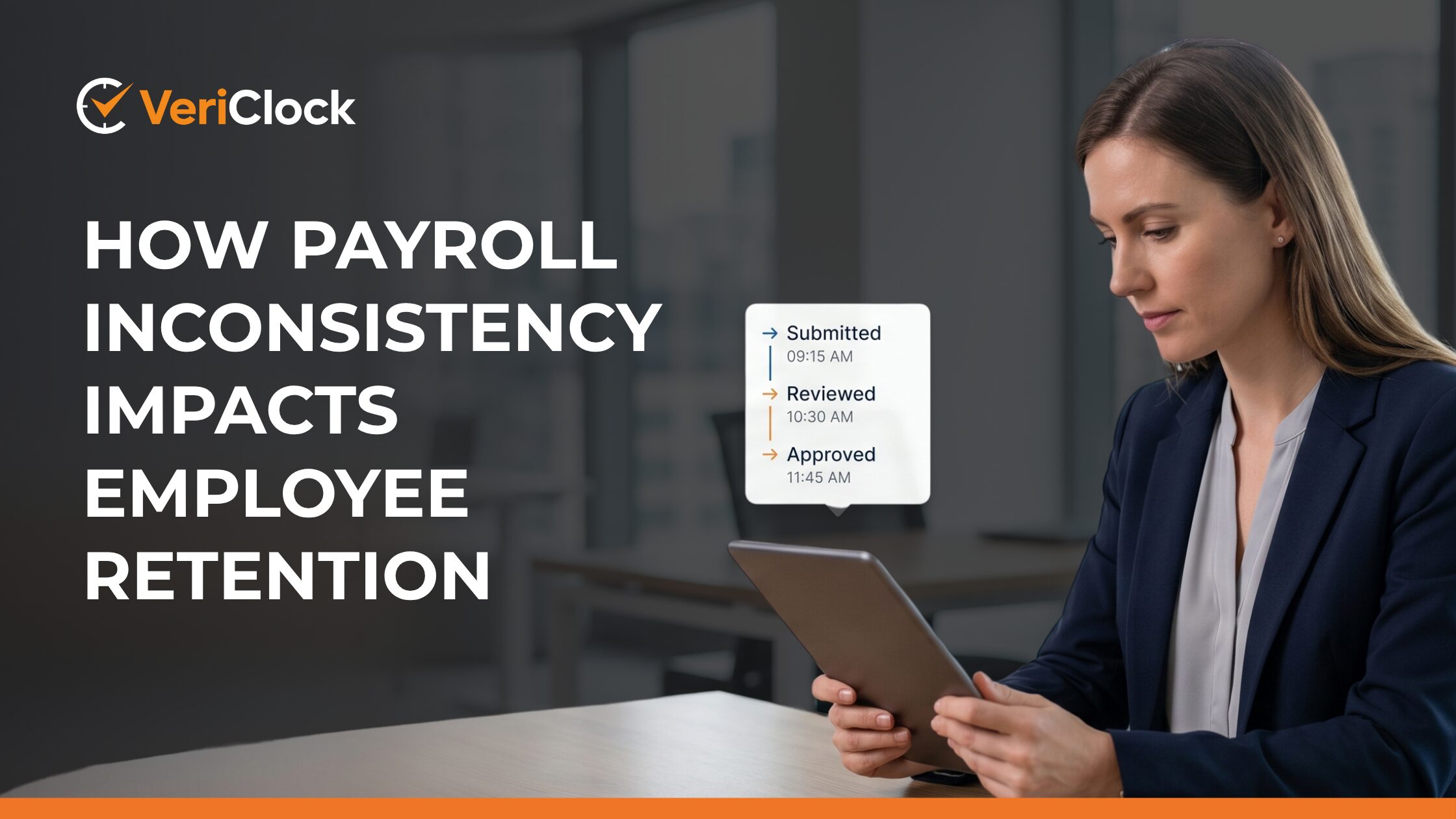
Approval workflows create accountability and transparency. Employees can see what was submitted, reviewed, and approved — before payroll is processed, not after.
Overtime and Policy Enforcement Matter More Than Culture
One of the fastest ways to lose trust is inconsistent overtime handling.
When overtime is applied manually or corrected after the fact, that’s where trust breaks down.
With systems like VeriClock, overtime rules are defined and applied automatically based on company policy as time is processed.
👉 VeriClock Overtime Rules, Time Types and Compliance Settings
Why this matters:
Policy-driven overtime ensures consistency. Employees are paid according to defined rules — not adjusted after payroll is calculated.
Scheduling Is a Retention Tool — Not Just an Operations Tool
Broken scheduling is one of the most overlooked drivers of employee frustration.
Employees need visibility and predictability — not last-minute changes and confusion.
When schedules are unclear, employees:
- Show up to the wrong job
- Miss expected hours
- Lose confidence in planning their time
VeriClock reduces this friction by connecting scheduling directly to time tracking and job structure.
Employees can:
- View assigned shifts in advance
- Receive real-time notifications of schedule changes
- Know where they are expected to be before the workday starts
- Reduce back-and-forth communication with supervisors
👉 Employee Scheduling & Workforce Notifications in VeriClock
Why this matters:
Clear schedules and real-time updates create consistency — and that consistency builds confidence in both work expectations and payroll.
Compliance and Transparency Drive Retention at Scale
As businesses grow, informal systems struggle to keep up.
Retention becomes a function of structure:
- Enforced time capture
- Consistent approval workflows
- Traceable audit logs
- Policy-driven payroll
👉 VeriClock Overtime Rules, Time Types and Compliance Settings
Why this matters:
Employees trust systems that are consistent. Governance builds that consistency.
Where VeriClock Fits
VeriClock is built for field-based businesses that need structured, enforceable time tracking.
It enables:
- Job-based clock-in with GPS verification
- Automated overtime calculation
- Structured approval workflows
- Real-time scheduling visibility
- Direct integration with payroll systems like Sage 50, Sage 100 Contractor, and QuickBooks
VeriClock replaces reactive payroll correction with controlled, predictable workflows.
Instead of repairing time after submission, it ensures accuracy at capture.
Retention Starts with Control
In 2026, employee engagement is not driven by HR initiatives alone.
It is driven by operational consistency.
When payroll is accurate, schedules are predictable, and approvals are transparent, employees trust the system.
And when employees trust the system — they stay.
Start your free VeriClock trial today and experience how prevention-based payroll control eliminates downstream correction before your next pay cycle.