
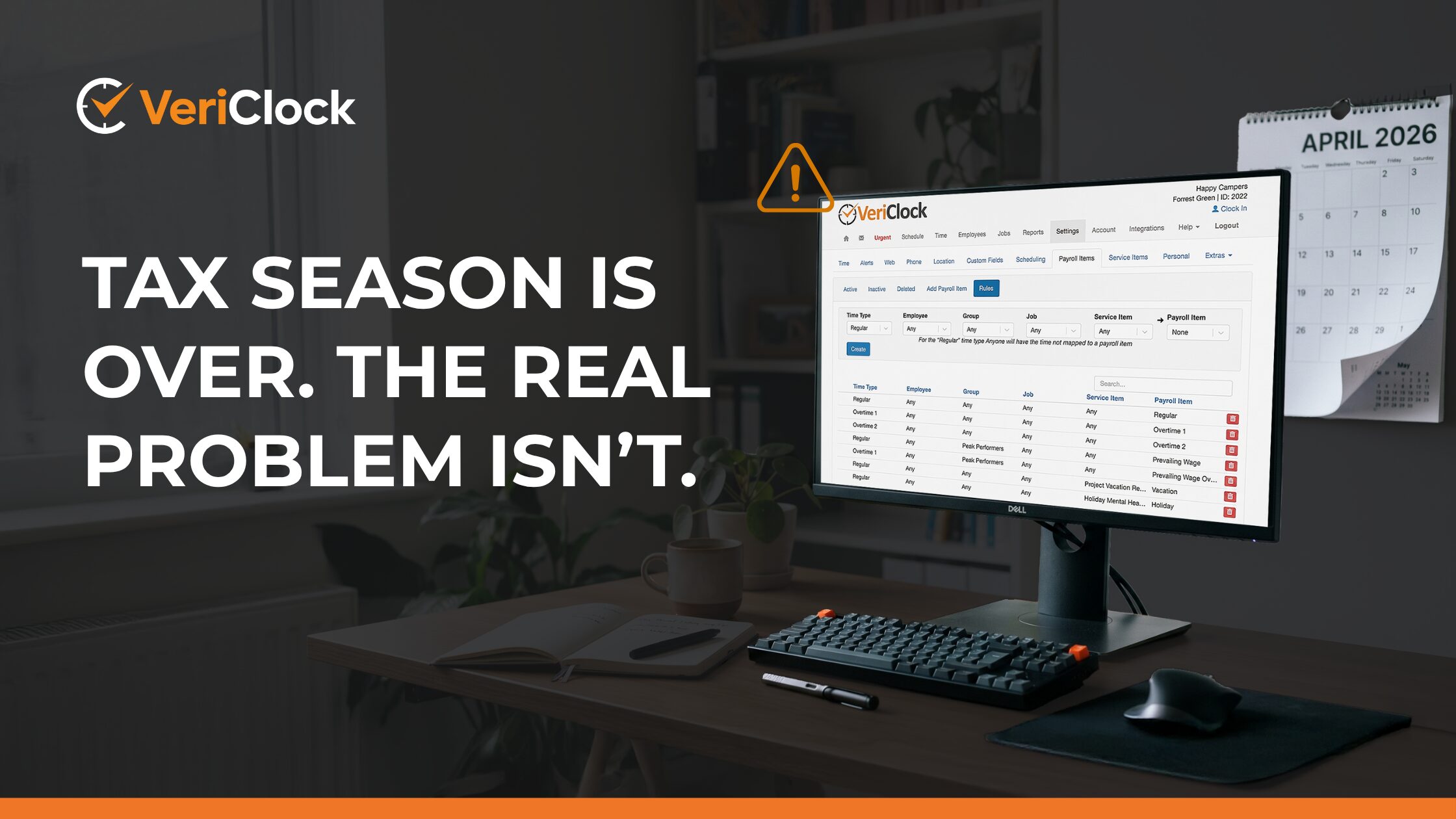
Tax Season Is Over — What It Exposed About Your Overtime Data
New IRS reporting rules, evolving Canadian labour standards, and rising wages are increasing payroll risk heading into 2026
Tax deadlines have passed. But for many U.S. and Canadian employers, filing didn’t close the loop—it exposed deeper structural issues.
What looked like a tax filing exercise has become a diagnostic moment for payroll systems.
What appeared during tax season as isolated payroll errors is now revealing something more consistent—and more concerning. Across both countries, organizations are uncovering the same patterns:
- Overtime miscalculations
- Blended wage categories
- Manual payroll adjustments
- Gaps between time tracking and accounting
The takeaway is becoming clear:
The biggest payroll problems don’t start in payroll—they start with time data.
For finance and operations leaders, this means payroll risk is now a data structure problem—not a calculation problem.
The Real Shift: Tracking Hours → Protecting Payroll
For years, time tracking systems were built around one primary function: recording hours worked. That model worked when teams were smaller, rules were simpler, and payroll complexity was limited.
But that model breaks down quickly as organizations grow.
Post-tax season, a consistent pattern has emerged across industries. The issue is not whether hours are tracked—it’s whether those hours are structured correctly before payroll runs. As companies scale, even small inconsistencies in how time is captured begin to ripple through payroll, reporting, and compliance.
Organizations are now dealing with:
- Multi-rate workforces
- Daily vs. weekly overtime misalignment
- Weak approval processes
- Heavy reliance on manual adjustments
Most systems can calculate overtime.
Very few can classify, enforce, and structure it correctly before payroll begins.
And that distinction is becoming critical as tax treatment and labor regulations evolve across both the U.S. and Canada.
United States: What 2025 Tax Season Just Revealed
In the United States, the rules themselves did not suddenly change—but how those rules are applied, interpreted, and reported has shifted in meaningful ways.
Tax season surfaced a gap between what payroll systems assume and what is now required in practice.
Under the Fair Labor Standards Act:
- Overtime applies at 40+ hours per week
- Pay is calculated at 1.5× the regular rate
That foundation remains stable.
What has changed is how overtime is interpreted, reported, and in some cases partially deducted—introducing a level of nuance that many systems are not equipped to handle.
⚠️ The New IRS Overtime Deduction (2025–2028)
One of the most important—and most misunderstood—changes is the IRS’s treatment of overtime income.
The IRS has introduced a more nuanced treatment of overtime income, which many payroll systems—and teams—are not prepared to handle cleanly:
- Only the premium portion (0.5×) qualifies
- Deduction caps: $12,500 (individual) / $25,000 (joint)
- Income phaseouts apply
- Overtime is not tax-free
Example:
- $20/hour × 10 overtime hours
- Regular pay → $160
- Overtime pay → $60
- Only $20 qualifies for deduction
Most payroll systems are not designed to isolate this premium portion cleanly—leading to incorrect reporting or missed deductions.
🚨 2026 Reporting Shift
- 2025 → No structured reporting requirement
- 2026 → Overtime classification required on W-2
Your time data must be properly structured before it ever reaches payroll reporting.
- Overtime is not properly separated
- Systems lack structured classification
- Reporting outputs are inconsistent
📊 Minimum Wage Increases (2026)
January 1 increases (19 states):
- Arizona → $15.15
- California → $16.90
- Colorado → $15.16
- Connecticut → $16.94
- Hawaii → $16.00
- Maine → $15.10
- Michigan → $13.73
- Minnesota → $11.41
- Missouri → $15.00
- Montana → $10.85
- Nebraska → $15.00
- New Jersey → $15.92
- New York → $17.00 / $16.00
- Ohio → $11.00
- Rhode Island → $16.00
- South Dakota → $11.85
- Vermont → $14.42
- Virginia → $12.77
- Washington → $17.13
Mid-year increases:
- Alaska → $14.00 (July 1, 2026)
- Oregon → Inflation-based (July 1, 2026)
- Florida → $15.00 (Sept 30, 2026)
- California Healthcare → $19–$25 (July 1, 2026)
Multi-state payroll fragmentation is now the norm.
Canada: No Single Rule — And No Single Failure Point
Canada does not operate under a single overtime framework; each province sets its own rules.
⚠️ Saskatchewan Shift
- Before → Midnight resets allowed artificial shift splitting
- After → Rolling 24-hour windows enforce true overtime
This increases reliance on system-level accuracy.
Minimum Wage Increases — Canada (2026)
- Federal → $18.15 (April 1, 2026)
- British Columbia → $18.25 (June 1, 2026)
- Alberta → $15.00
- Saskatchewan → ~$15.00 (Oct 1, 2026)
- Manitoba → $16.40 (Oct 1, 2026)
- Ontario → ~$17.20 (Oct 1, 2026)
- Quebec → $16.60 (May 1, 2026)
- New Brunswick → ~$15.65 (April 1, 2026)
- Nova Scotia → ~$15.40 (April 1, 2026)
- Prince Edward Island → $17.00 (April 1, 2026)
- Newfoundland & Labrador → ~$15.60 (April 1, 2026)
Payroll systems must track both rates and effective dates.
The Real Risk: Error at Scale
- Employees
- Jurisdictions
- Pay cycles
Small inconsistencies become systemic liabilities.
What This Means for Your System
This complexity requires system-level enforcement, not manual review.
Overtime compliance depends on data integrity at scale.
How VeriClock Solves This — Before Payroll
VeriClock structures, validates, and approves time data before payroll.
Enforced Overtime Logic
Setting Up Overtime Rules in VeriClock
Structured Approval Workflows
Setting Up Time Entry Approval Workflows
Clean Payroll Reporting
Generating Payroll Reports in VeriClock
Direct Accounting Integrations
Accounting Integration – VeriClock & QuickBooks Online
Final Takeaway: Payroll Accuracy Starts with Time Data
Tax season exposed existing payroll issues rooted in time data structure.
Future compliance depends on structured, validated time data upstream.
Frequently Asked Questions (FAQ)
What qualifies as overtime in the U.S.?
Hours beyond 40 per week at 1.5× pay.
How is overtime calculated in Canada?
Varies by province with different thresholds.
What is the IRS overtime deduction?
Only the 0.5× premium portion qualifies with caps and limits.
Why is payroll data structure important?
It ensures compliance, reporting accuracy, and audit readiness.
How does VeriClock help?
It enforces structured time tracking before payroll, eliminating errors at the source.